
Srpski | Русский | Deutsch | Nederlands
If you wake up with a tight jaw, sensitive teeth or a morning headache, there is a good chance you grind your teeth in your sleep. Bruxism slowly and silently wears down enamel, chips tooth edges and overloads the jaw joint – and most people find out only when a dentist spots the damage. The good news: protection is simple, comfortable and fully individual. Book a consultation
Night guard at a glance
- What it is: a custom night splint that protects teeth from grinding and clenching during sleep.
- Made from: a 3D scan of your jaws – hard outer layer, soft inner lining.
- Process: two short visits (scan + delivery).
- Combination: with Botox in pronounced bruxism.
- Lifespan: roughly 6 months to 2 years.
- Price: set at the exam – see the price list.
What is a night guard (protective splint)?
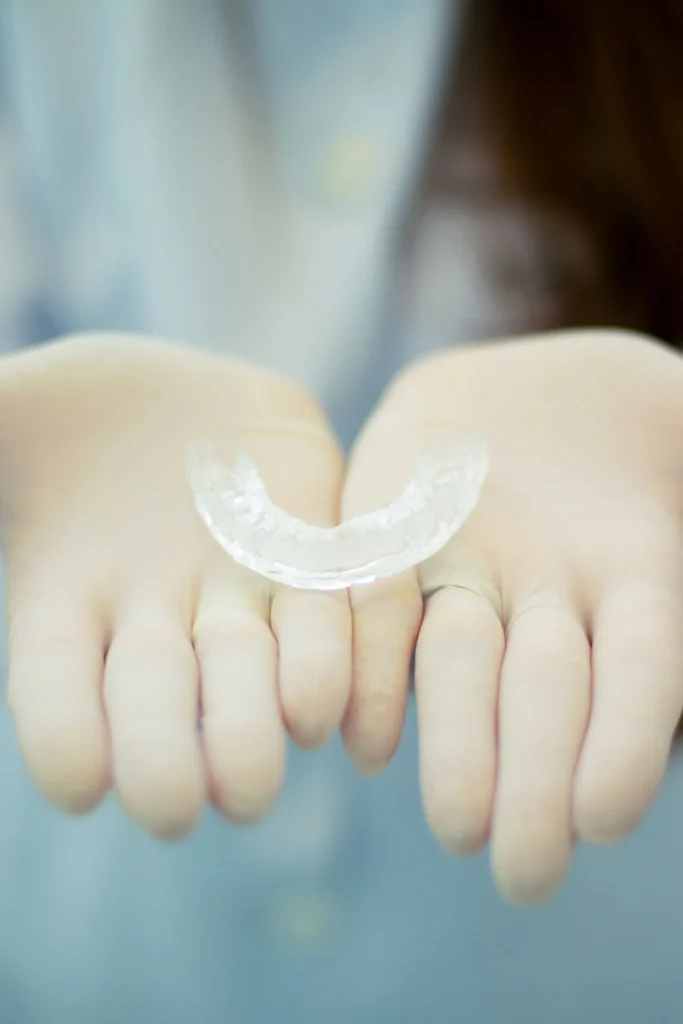
A night guard is a thin, clear tray worn over the teeth while you sleep. Ours is made from an exact 3D scan of your teeth, with a hard outer layer that absorbs the force of grinding and a soft inner layer that hugs your teeth. Unlike generic pharmacy guards, a custom splint does not slip, does not irritate the gums and does not change your bite – which is why people actually wear it.
Why protect your teeth in time
Uncontrolled grinding gradually leads to worn and cracked enamel, broken fillings and crowns, tooth sensitivity, tight jaw muscles and morning headaches. A splint does not „cure“ the habit, but it takes the entire impact itself – your teeth, restorations and joint stay intact. It is the least expensive way to protect what is most expensive to repair.
How it is made – no unpleasant impressions
At the first visit we examine your teeth and take a digital 3D scan of your jaws – no trays, no impression material, no gag reflex. Based on the scan, the laboratory fabricates a splint matched precisely to your bite. At the second visit we deliver the splint, check the fit and give you wearing and care instructions. The whole process takes just two short visits.
Who needs a night guard
- people who grind or clench their teeth in their sleep (a partner often hears the sound),
- patients with visibly worn tooth edges or enamel cracks,
- patients with jaw muscle tension, joint clicking or morning headaches,
- anyone with larger restorative work (crowns, veneers, implants) that should be protected.
Splint and Botox – they work together
The splint protects the teeth, while Botox in the jaw muscles reduces the clenching force itself. In pronounced bruxism the best result comes from combining them: Botox relaxes the muscle, the splint protects the teeth from the remaining force. Read more on our Bruxism – teeth grinding page.
Wearing and care
The splint is worn at night, every night. In the morning, rinse it with cold water and a soft brush, let it dry and keep it in its case. Never use hot water – it deforms the material. At your regular check-ups we assess the splint and your bite.
How long does one splint last?
Depending on grinding intensity, one splint lasts roughly 6 months to 2 years. With stronger bruxism the splint wears out faster – and that is exactly the point: the splint wears out instead of your teeth.
Price
The price depends on the type of splint and includes the exam, 3D scan and fabrication. The exact price is set at the examination – see our dental price list.
Frequently asked questions
Is it uncomfortable to wear?
For the first few nights you feel the splint, but the vast majority of patients get used to it within a week. The custom fit means it neither slips nor presses.
Can I wear it during the day?
Yes – if daytime clenching is diagnosed, it can be worn during the day as well; we assess this at the exam.
I have dentures/crowns – can I have a splint?
Yes, and we especially recommend it then, because it protects restorations from fracture.
How often are check-ups?
First check after 2-4 weeks, then at regular six-month examinations.
References
- The efficacy of occlusal splints in the treatment of bruxism: A systematic review. pubmed.ncbi.nlm.nih.gov/33652054
- Comparative analysis of different types of occlusal splints for the management of sleep bruxism: a systematic review. pubmed.ncbi.nlm.nih.gov/38182999
Book your exam – based on a 3D scan we will assess your teeth and recommend the protection that fits you. Book a consultation