
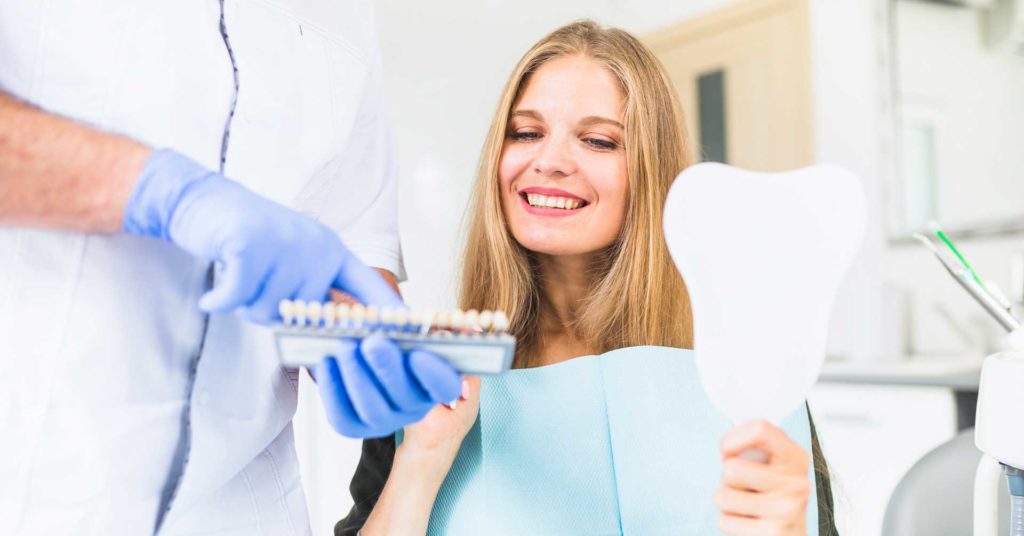
In situations where there is a so-called deep bite, a pronounced irregularity in the position of the teeth, or their discolouration, prosthetics can be an excellent choice for solving these problems. For a smile to be beautiful and harmonious, current trends in dentistry favour metal-free crowns, which completely imitate the look, colour and translucency of natural teeth. They are made of zirconium and layered with ceramic of exceptional quality. Our body accepts metal-free crowns well, as they are made of a safe material characterised by strength and stability, and because it transmits light, the teeth look milky-white, natural, smooth and shiny. The use of interdental brushes is obligatory so that the gums are kept healthy and clean and the longevity of the restorations is guaranteed.

Have you heard of veneers, also called dental facets or shells, whose appearance and resistance strongly resemble tooth enamel? That is exactly why they are the most aesthetically acceptable option, as they give teeth a natural look. Our dentist will assess whether you are the right candidate for this procedure, which involves minimal grinding of the tooth and bonding composite or ceramic to the front surface of the enamel, preventing potential irritation and gum recession. The advantage of this method is that veneers hardly change colour under the influence of coloured food or tobacco. There are composite and ceramic veneers; ceramic ones last longer, although the lifespan of composite ones can also be extended with thorough tooth brushing. If you have a gap between your teeth, discolouration caused by tetracycline-based antibiotics, or white spots caused by a mineral imbalance in the enamel, ceramic veneers are the specialists’ recommendation. They should certainly be avoided if a tooth has darkened after endodontic treatment, because in that case a dark reflection will inevitably appear and can impair the aesthetics of the jaw.
Metal-ceramic crowns have a metal base that can be made of cobalt, nickel, gold or titanium alloy. This base is covered with ceramic, which provides a natural look. While the metal gives strength, the ceramic makes the teeth look as natural as possible. In people with bruxism (teeth grinding), this type of restoration has proved to be an ideal solution. It is particularly recommended for the aesthetic rehabilitation of teeth in the side region of the jaw, which is heavily loaded by chewing food. Temporary crowns allow you to carry on with your private and professional activities; they are made of composite materials and represent a kind of preparation for the fixed restoration you have chosen in consultation with our doctors.

If one or more teeth are missing, a partial denture is an excellent option. These restorations are fixed to the natural teeth and must be properly maintained and removed regularly. What matters is that the function of eating and speaking is fully preserved, without any discomfort. A partial denture rests on the jawbone and is held to the other teeth by clasps. When a bridge cannot be placed, this variant has proven itself in practice. An unwanted effect is gum recession caused by the pressure of the clasps, which can lead to periodontal disease.
If there are no teeth in the jaws at all, a full denture is the dentist’s advice. It covers both jaws and is placed over the gums, that is, over the jawbone. You can eat and speak normally, and when it is made well both aesthetically and functionally, few people could suspect that you wear a full denture. It takes some time to get used to the presence of the denture in the mouth, and the oral tissue should be rested at night by placing the denture in a special solution. Increased salivation and unpleasant chafing are not uncommon, so a visit to the doctor is necessary at the beginning so that any required adjustment can be made.
Prosthetic restorations can last quite a long time. It is important to stress the value of regular six-month check-ups, at which the condition of the teeth, gums and bone is monitored and X-rays are taken when needed. Proper dental hygiene and the use of dental floss and interdental brushes maximally extend the life of prosthetic restorations, as well as of the teeth themselves. With dentures, their stability and their relationship to the remaining teeth are monitored, which is why adjustments and relining are carried out from time to time.
Treatment price list View our treatment prices Call us Book your treatment