
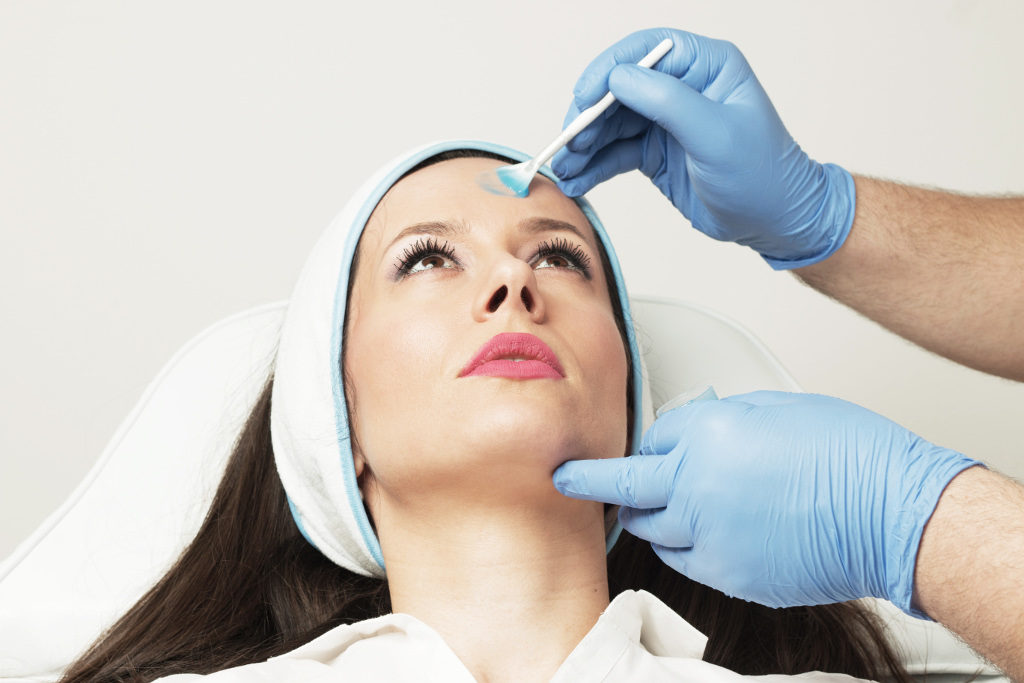
Chemical peel at a glance
- What it treats: uneven skin tone, fine lines, sun spots and pigmentation, shallow acne scars, enlarged pores and dull, tired-looking skin
- Principle: a controlled application of medical-grade acids removes the surface layers of the skin and triggers its natural renewal
- Treatment time: about 30-45 minutes, including skin preparation
- Recovery: depends on peel depth – from mild redness after superficial peels to visible peeling for a few days after medium peels
- Number of sessions: usually a course of 3-6, spaced two to four weeks apart
- Price: depends on the type of peel – see the price list
What is a chemical peel and how does it work?
A chemical peel is a medical-aesthetic procedure in which a carefully selected acid solution is applied to the skin, causing a controlled removal of the surface layers of the epidermis. The skin responds to this controlled „injury“ with accelerated renewal: epidermal cell turnover speeds up, while the dermis is stimulated to produce new collagen and elastin. The result is skin with a more even tone, smoother texture and a healthier glow.
Unlike mechanical exfoliation, which works only on the surface, a chemical peel acts at depth – which is why it can treat conditions a cream cannot reach: hyperpigmentation and sun spots, shallow acne scars, enlarged pores, fine lines and dull, tired skin.
Types of peel by depth
The choice of acid and its concentration determines the depth of action – and with it the indication, the intensity of peeling and the length of recovery:
- Superficial peel – gentle acids such as glycolic, lactic or salicylic act on the outermost layer of the epidermis. Suitable for refreshing the complexion, minor irregularities and as an introduction to regular care; recovery is short, with mild redness that settles quickly.
- Medium peel – stronger protocols (most often based on trichloroacetic acid, TCA) reach the mid layers of the epidermis. Used for more pronounced pigmentation, fine lines and shallow scars; followed by visible peeling for several days.
- Deep peel – reserved for significant skin damage and performed only under strict medical indication and supervision.
Choosing the right type and strength of peel is crucial for safety and results, especially in darker skin types – which is why treatment is always planned after an examination and assessment of your skin.
Who is a candidate, and when to postpone?
A chemical peel is a good choice for anyone who wants a more even complexion, smoother skin and reduced visibility of spots, fine lines or acne marks. Treatment is postponed in cases of active herpes, open wounds or inflamed lesions on the face, recent sun or tanning-bed exposure, pregnancy and breastfeeding, and isotretinoin therapy within the previous several months. Autumn and winter are considered the most suitable seasons for peeling, primarily because of weaker solar radiation.
What does the treatment look like?
The treatment begins with thorough cleansing and degreasing of the skin, after which the acid solution is applied in one or more layers while the skin’s reaction is continuously monitored. The sensation during application is mild tingling or warmth, and it passes quickly. Depending on the protocol, the acid is neutralised or rinsed off after a set time, followed by soothing and protective products. The whole treatment takes about 30-45 minutes and superficial protocols require no anaesthesia.
Recovery and aftercare
After a superficial peel the skin is usually mildly red for a day or two, while medium protocols bring visible peeling for several days. During this period it is important to:
- never pick at the flakes – the skin sheds on its own;
- regularly apply the recommended soothing and restorative creams;
- use a high-protection sunscreen (SPF 50) without fail and avoid direct sun for several weeks, because renewed skin is more sensitive to UV and the risk of new pigmentation is higher.
How many sessions are needed?
The skin looks fresher and more even after a single treatment. For a stronger and longer-lasting result – with spots, scars or fine lines – a course of 3-6 sessions spaced two to four weeks apart is usually recommended, with a plan adjusted to how your skin responds.
How much does a chemical peel cost?
The price depends on the type and depth of peel chosen after the examination. See the price list for current prices, and book a consultation for a protocol recommendation tailored to your skin.
A patient’s experience

„I had always been bothered by the spots and marks I had got from sun exposure, and I successfully concealed them with quality cosmetics. However, you all know that feeling when you wash your face, look in the mirror and are left alone with your imperfections. At ESTERA I informed myself in detail about the advantages of a chemical peel, and after extensive instructions from the specialists I decided on this treatment. During the peeling period I followed the sun-protection advice and applied the recommended creams to achieve even better effects. I used the holiday days after New Year, and then proudly showed my new face. The mirror and I made peace. We are now best friends.“
– the experience of Ivana Gavrilović Stanković, a graduate philologist
Frequently asked questions about chemical peels
Does a chemical peel hurt?
During the application of the acid you feel mild tingling or warmth that passes quickly. Superficial peels require no anaesthesia and are well tolerated.
When will I see the result of a chemical peel?
The skin looks fresher and more even after the first treatment, and the full result develops once peeling and renewal are complete – usually within one to two weeks. With a course of treatments the result deepens from session to session.
How long does the peeling last?
With superficial peels flaking is mild and short-lived; with medium peels it lasts several days. Flakes must never be picked off – the skin is cared for with the recommended creams instead.
Can a chemical peel be done in summer?
Autumn and winter are recommended, when solar radiation is weaker. If a peel is done during stronger sun, strict photoprotection (SPF 50) and avoiding direct exposure are mandatory.
Is a chemical peel safe for sensitive skin?
Yes, provided the acid and concentration are chosen correctly. That is why an examination always precedes treatment – the protocol is selected according to your skin type and condition, and very sensitive skin starts with the mildest protocols.
Read more
- Hyperpigmentation and melasma: how to remove dark spots
- MicroNeedling: skin renewal through collagen stimulation
- Facial biorevitalisation: deep hydration and skin revitalisation
Book a consultation: +381 66 378 372
Price list See our treatment prices Call us Book your treatment