
Srpski | Русский | Deutsch | Nederlands
Spots, redness, an uneven complexion – one acronym is mentioned for all three: IPL. The technology has been around for decades and is useful in the right hands, but it is not for every skin or every spot. This guide explains how IPL works, who it helps and where its limits are – and openly: we do not perform it at ESTERA, so we also list the methods we use to solve the same problems.
Book a consultationView the price list
IPL at a glance
- What it is: intense pulsed light (IPL) – a broad, filtered spectrum of light, not a laser
- Goal: dark spots, redness and fine capillaries, uneven tone, „photorejuvenation“
- Sensation: a brief snap with each flash; minimal downtime
- Course: usually about 3 sessions, seasonal (autumn to spring)
- Who it is NOT for: darker phototypes, active melasma without assessment, recent tanning
- At our clinic: ESTERA does not perform IPL – we treat spots, redness and capillaries with Fotona/Nd:YAG technology (see below)
What is IPL and how does it differ from a laser?
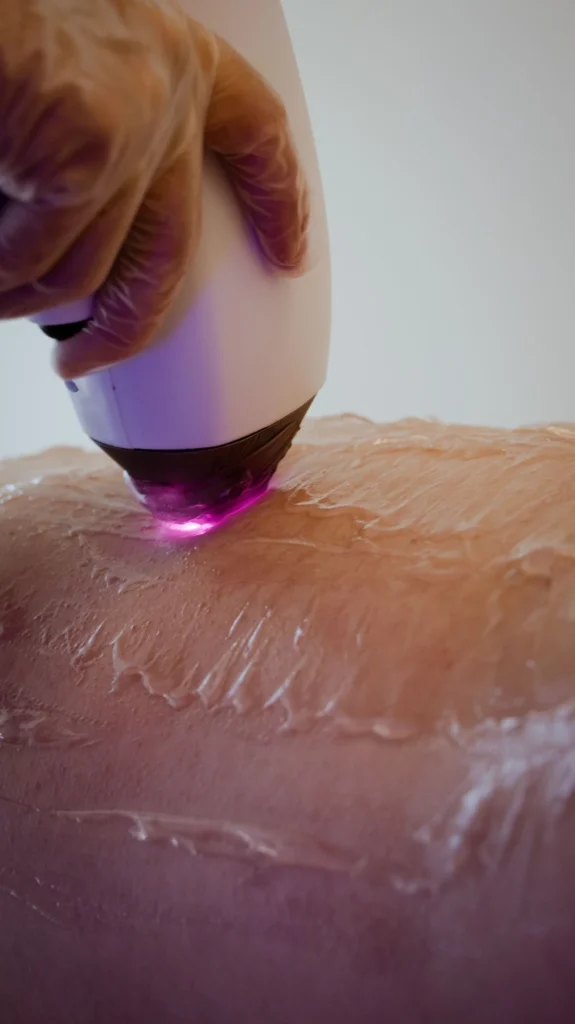
A laser emits a single, precise wavelength of light; IPL emits a filtered slice of a broad spectrum. That is why one IPL device can target several different „targets“ in the skin – melanin in spots and haemoglobin in capillaries – but it is less precise than a laser. The light converts to heat in the targeted structure: spots darken and then flake off, and fine capillaries close.
What is IPL used for?
The best-documented uses are post-inflammatory dark marks (e.g. after acne), superficial dilated capillaries and couperose-type redness, and uneven tone and texture as part of „photorejuvenation“. In lighter skin phototypes (I-III) IPL is well studied across two decades of clinical trials; in darker skin the risk of unwanted pigmentation rises, so other methods are often chosen.
What do treatment and recovery look like?
Each pulse feels like a brief, warm snap with a flash; devices have built-in cooling. After treatment the skin is flushed for a few hours, and treated spots temporarily darken and flake off over 1-2 weeks. Daily activities resume immediately, with strict sun protection. A course is usually about 3 sessions, 3-4 weeks apart, and the sun-poor season is the most suitable time.
Honest limits
IPL is not for darker phototypes and requires sun discipline before and after treatment. It can even worsen melasma if not assessed properly – which is why unclear pigmentation is assessed first. Couperose, meanwhile, is a tendency that returns: a course of treatments visibly reduces redness, but avoiding triggers and an occasional maintenance session are part of the plan. A permanent result is not promised.
What do we offer at ESTERA?
ESTERA does not perform IPL treatments – we wrote this page as a guide because patients ask about it often. We solve the same problems with lasers, at greater precision: dilated capillaries and redness are treated with the Nd:YAG laser (laser capillary removal; see also our rosacea and capillaries guide), and spots and uneven tone through our hyperpigmentation and melasma programme, always after a skin analysis. For overall rejuvenation and complexion there is also the Fotona4D laser lift.
Frequently asked questions about IPL
Is IPL the same as a laser?
No. A laser has one wavelength and targets more precisely; IPL covers a spectrum and suits several superficial problems at once, but is less precise.
Does it hurt?
The sensation is a brief snap with each flash; with built-in cooling most people tolerate it well.
How many sessions are needed?
Most often about 3, spaced 3-4 weeks apart; capillaries and spots are then maintained occasionally.
Do the spots come back?
They can – especially with sun. That is why SPF is part of every plan, and couperose and melasma are tendencies managed long-term.
Why don’t you offer it?
For the indications IPL covers we have laser technology (Fotona, Nd:YAG) that targets more precisely and more broadly – which is why we choose it over IPL.
References
- Intense pulsed light for pigmented and vascular lesions and skin rejuvenation: two decades of clinical trials. Dermatological Reviews. 2021. DOI: 10.1002/der2.55