
Srpski | Русский | Deutsch | Nederlands
„Tightening without needles and without downtime“ – that is how radiofrequency is most often advertised, and it is one of the most searched skin-firming technologies. What of that is true, who does the method realistically help, and where are its limits? This guide explains the principle, the types of treatment and the expectations – and we say openly that we do not perform it at ESTERA, along with the alternatives we do offer for the same goal.
Book a consultationView the price list
Radiofrequency at a glance
- What it is: heating of the deeper skin layers with electromagnetic energy, without injuring the surface
- Goal: tightening of lax skin, softening of fine lines, better texture
- Sensation: pleasant to more intense warmth; no needles
- Course: usually 3-6 sessions, depending on the device
- Downtime: none (non-ablative methods); fractional RF brings 1-3 days of redness
- At our clinic: ESTERA does not perform RF treatments – for tightening we use Fotona lasers (see below)
How does radiofrequency tighten skin?
Radiofrequency (RF) energy passes through the skin and converts to heat in the deeper layers. When the dermis is heated to a controlled temperature, existing collagen fibres partially contract and – more importantly – a renewal process begins: in the weeks after treatment, fibroblasts build new collagen. That is why results develop gradually, usually over 4-12 weeks.
Unlike lasers, RF energy does not depend on melanin – skin colour does not determine how much energy is absorbed, so the method suits all phototypes and can be done year-round (with the usual sun protection on freshly treated skin).
What types of RF treatment exist?
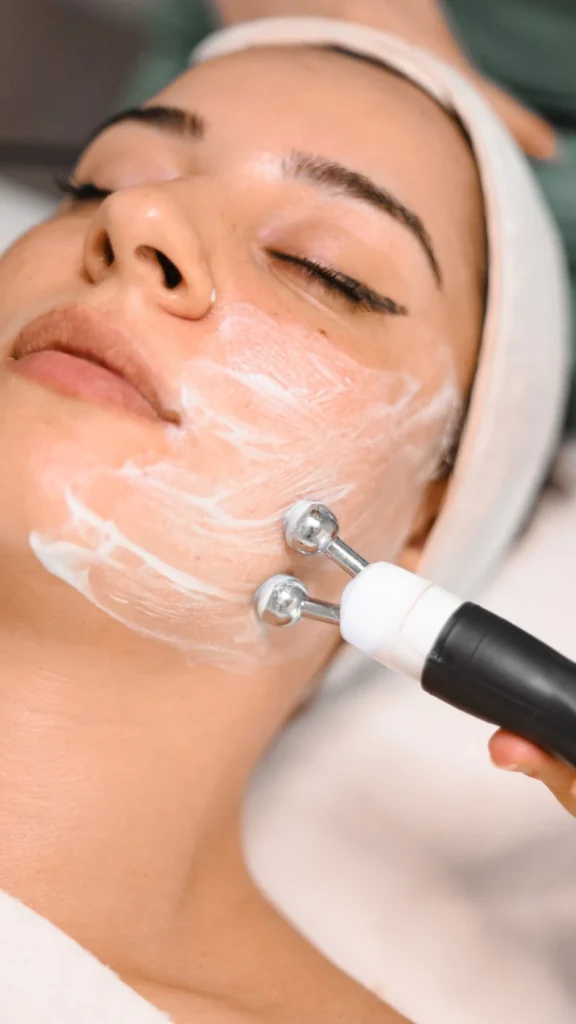
- Non-ablative RF tightening – an applicator glides over the skin and heats the dermis without any surface injury; no downtime, a course of sessions.
- Fractional RF – energy is delivered through small electrodes in points; it targets texture, pores and shallow scars, with 1-3 days of redness.
- RF MicroNeedling – needles carry the energy directly into the dermis; a stronger effect on texture and scars, with a few days of recovery.
Which problems does it solve – and which not?
RF gives its best results with mild to moderate laxity of the face, neck and décolleté, fine lines and uneven texture. Honestly: no non-surgical method dramatically fixes moderate-to-severe laxity – RF is no replacement for a surgical lift, and claims of „visibly tightened“ skin after one session deserve a marketing discount. With more pronounced laxity, a realistic assessment of what makes sense at all is needed.
What do treatment and recovery look like?
With classic RF tightening the applicator is moved over the area until the skin reaches the target temperature; the feeling is warmth, with no needles and no downtime – you return to your activities immediately. Fractional RF leaves redness and fine micro-crusts for 1-3 days. A course is usually 3-6 sessions a few weeks apart, and the result builds over the months after the final session.
What do we offer at ESTERA?
ESTERA does not currently perform radiofrequency treatments – we wrote this page as a guide, because patients ask about it often. For the goal RF addresses – firmer, younger-looking skin – we offer Fotona laser programmes: Fotona4D laser lifting (a multi-step protocol for tone and texture, without needles), Fotona TightSculpting (tightening and contouring, face and body) and Fotona Deep Rejuvenation. Lasers additionally work on the skin surface (spots, texture, complexion), which RF does not. Which choice is better for you depends on the degree of laxity, your skin type and your goal – we assess that at the consultation and tell you openly.
Frequently asked questions about radiofrequency
Does RF really work?
Yes – with realistic expectations. With mild-to-moderate laxity and fine lines the effect is measurable and supported in the literature, but it is subtle and builds over a course.
Does it hurt?
Classic RF tightening feels like a warm massage; fractional RF and RF MicroNeedling are more sensitive and are done with numbing cream.
How long do results last?
Usually a year or more, with maintenance – ageing continues, so an occasional maintenance session is recommended.
Is RF safe for darker skin?
Yes – the energy does not depend on melanin, so RF suits all phototypes, unlike certain lasers and IPL.
RF or laser?
They work differently: RF heats the depth and leaves the surface alone, lasers work on both. They are often combined; the choice depends on the problem being treated.
References
- Weiss RA. Noninvasive radio frequency for skin tightening and body contouring. Semin Cutan Med Surg. 2013;32(1):9-17. PMID: 24049924
- Dayan E, Burns AJ, Rohrich RJ, Theodorou S. The use of radiofrequency in aesthetic surgery. Plast Reconstr Surg Glob Open. 2020;8(8):e2861. PMC7489578.